Science Notebook Freebie

I wanted to hop on today and share a little science notebook freebie that I made for you all. I thought it would be helpful to create a little science cheat sheet for students to glue onto the inside of their notebooks.

I included the basic metric units, some other scientific units that I thought would be helpful, the steps to the CER and Scientific Method, the types of variables, the equation for force = mass x acceleration and the periodic table!

I hope this helps your science students this year!

Just click the image to download your free copy!


End of the Year Science Freebie

I think we can all agree that this school year didn't end quite like we had imagined or hoped. I always look forward to those final days with students.

This year, since I am teaching 8th grade, it makes me extremely sad because they will be moving on to high school next year and I won't see them again.

I wanted to put together a little something for my students to keep the science going this summer, if only for a moment. I also wanted to find something that wouldn't break the bank!

So, I assembled little bags with the materials to make a balloon rocket at home.

This project cost me less than $20! I might have spent a few hours putting them together, but I think it's worth the time and effort to give students a little science in their summer.

The Materials to Purchase:

  • balloons
  • string
  • straws (I used paper straws from Dollar Tree)
  • snack bags
  • colored paper to print your freebie on
Download the freebie by clicking the image below.


I only provided students with enough to make one balloon rocket. You could provide them double the materials and allow them to have balloon races. Students will also need tape, but I did not include the tape for them. That would have cost a little more than I wanted to spend and I figured most kids probably had tape at home. 

Here is a little video for assembling your bags!


I am hoping they enjoy this fun little STEM activity! I hope you can use it for your students too!


5 Fun Games for Digital Learning (Free Downloads)

This time has been incredibly difficult for teachers. Being away from our classrooms, our students, our colleagues, and our school communities has taken it's toll on us all. But, as teachers, we do what we do best. We do anything we can to serve our students and make learning online as much like our own classrooms as we can. I have been trying to find that perfect balance between the right amount of work on virtual meeting time to make sure my students are successful.

However, it is SO important to keep those connections with students going and let them know that we miss them and love them. One great way to do that is to play games with them when you meet on Zoom, Google Meet, or WebEx in my case.

I am going to talk about some really fun games that my students and I have played that I also tried to make relevant to my content area. These games could be made relevant for any content area as well.

Some of these games are a culmination of ideas I've seen on Instagram or versions of things I've seen. I will credit teachers where I can.

Scavenger Hunt with a Twist
We have all seen the typical scavenger hunt where you have students race to find items in there house and bring them back. Students LOVE this! But I was watching my IG stories one day and Kimberly from The Science Stalker suggested having students find items that started with specific letters. She had a word in mind that the first letter of each item would spell. For example, if you wanted them to unscramble the word science, you would have students hunt for things that started with each of the letters in that word (sock, clock, etc...) You would have them search for the items out of order and then have them try to unscramble the word.

I did this on Earth Day for each of my science classes. Each class had a different word related to Earth Day because you know middle schoolers like to talk to each other! Anyway, it was a big hit and they loved it! This would be a great way to introduce a lesson topic.

The Points Game

My girl Rachel at the Tattooed Teacher shared this one. This game is just a great way to connect with your students, build relationships, and just have a little fun. You will explain to students that they can earn and lose points for doing the activities that will be presented to students. If they have not done the activity, they do not gain or lose any points. You will want to give them an example like I have not yelled at anyone today so I do not lose 10 points, but I do not earn points either because this is a negative activity.

Then you present slides of different scenarios. (ie. If you have argued with someone -10, If you are wearing shoes or socks +1 per size on one slide) You can come up with as many different scenarios as you like. You can give the winner with the most points at the end a virtual prize!

Simon Says Science 

You can really do this with any subject area, but everyone knows how to play Simon Says. Just call out a statement like Simon Says touch your nose if Alfred Wegener propose the theory of continental drift. Offer some false statements like the following --> Simon Says hop on one foot if the crest is the lowest part of the wave. If students perform the action, they are out of the game.

Guess the Science Gibberish

This is another fun one that I got from Kimberly at the Science Stalker. However, I added the science twist to mine! You can download her free game HERE. For this game, it is a like the game Mad Gab. There are seemingly nonsense phrases, but when said together quickly sound like a word or phrase. I created some of my own based on our science vocabulary. You can download my editable science version by clicking HERE. We played this as a class last week and it was hilarious!

Five Second Rule

This last game is one that I plan on playing with my class this week and I think it will be a blast. You show a student a topic and they will have five seconds to name 3 things that fit the topic. For example, name three brands of shoes. My students and I will be playing this with a science twist. It will be a great way to review what we have learned and have a little bit of fun! Click the image below to download your free copy!


I hope this helps make your virtual teaching a little bit easier and little more fun! I would love to know what fun games you are playing with your students!


Science Podcast Episode Guide

So as many of you may already know, I made the switch this year to teaching middle school science and I absolutely LOVE it! I don't know why I spent so many years teaching elementary. I won't go on and on about the many reasons WHY, but just take my word for it.

Podcasts have become a big thing in education in the last couple of years. I know personally, I love listening to podcasts on my way to work every morning. True Crime is my favorite genre! My Favorite Murder and Sword and Scale are my two go to podcasts that I listen to on my daily commute.

When I taught third grade, we listened to a podcast called Six Minutes each day when we came in from recess and the students loved that time. You could hear a pin drop....It was a daily story that kept their attention and left them wanting more each day!

As a science teacher now, I've been looking for a way to incorporate podcasts into my science classroom, but just hadn't found the time to really look into all the science podcasts out there and what they have to offer. There are so many wonderful science podcasts with SOOOO many episodes.

I had a thought that I just needed to comb through each podcast and come up with guide broken down by podcast, topic, title, episode, and length so that when I want to use one, I can just go to my guide and pick one. I know this is going to make it less daunting for me to use a podcast in one of my lessons instead of spending hours (which is literally what I did creating this guide) looking for just the right episode to correspond to my lesson.

I created a Google Sheet and added tabs across the bottom for different scientific topics. At the top, I listed the title of the Podcast, the topic that the episode covers, the title of the episode, the episode date, and the length of the episode. You can see in the example below how it is set up.


Science genres included are:

  • Earth and Space
  • Biology
  • Earth (plate tectonics, oceans, atmosphere, volcanoes, earthquakes)
  • Earth's History (fossils, dinosaurs, evolution)
  • Ecology
  • Light and Sound
  • Environment
  • Weather
  • Health
  • Scientific Method
  • Chemistry
  • Physics
  • Geology
  • Genetics

The podcasts that I used are:

  • Science Weekly
  • 60 Second Science
  • Brains On Science
  • Science Friday
  • Tumble
  • Fun Kids Science Weekly
  • But Why
  • Wow in the World
  • The Show About Science
As new episodes are added to each podcast, I plan on updating the list each month. I hope you all find this document helpful for your science classrooms. If you would like to make a copy, please download it HERE

For future updates, you will need to come back and make a copy again. If you know of any other great science podcasts for kids, let me know and I will check them out and consider adding them to the guide!


3rd Grade Social Studies Pacing Guide (South Carolina 2020 Standards)

Where are my SC there grade teachers? I know many of you have been apprehensive about the new Social Studies standards that were released earlier this year. I have had so many of you ask me if I was going to be creating new social studies units for the new standards and the answer is yes!


I know I am no longer teaching 3rd grade, but 3rd grade social studies is my heart and I have so many dedicated followers that I feel like I would be letting you down if I didn't!

Today I worked on making a shortened version of the standards and a standards checklist. After I accomplished that, I really looked at what the standards were asking. I broke each standard down into smaller bits and voila, the pacing guide was born.

These standards really want students to understand the physical features, climate patterns, and cultural characteristics of places around the world, so students will spend the first part of the year learning about continents and oceans, maps, what physical features are, what culture and economy is, what climate patterns are, and how all these things work together to affect people and where they live. During each unit, students will conduct research on a specific region of the world to apply what they have learned.

You can download your free copy of this pacing guide HERE.


8th SC Science Support Document {Shortened Version}

I posted on my Instagram this past week about the shortened version of the support document that I created. The state department's version has so much extra stuff on it and I just wanted something easy to print and read! I had been thinking about doing this FOREVER and finally got around to doing it!

I hope you find this as helpful and useful as I have!

Here is a sample of what it looks like.

Click on the picture below to grab your free download!


Pace Out Your Year Like a Boss {Free Pacing Guide Template Included}

You guys know I LOVE me some planning. I get soooo excited at the end of every year for the prospect of planning for a new year. This coming year was extra exciting because I got to plan and pace for a whole new grade level and content area. I relished EVERY minute of it.

I spent a lot of time working on this pacing guide for the upcoming year, but there are a few key things you need to keep in mind when you start to pace out your year.

YOUR DISTRICT EMPLOYEE CALENDAR

This is the first thing you will need when pacing and planning out your year. This will help you create a template for your year so that you know what days and weeks to block off of your pacing guide. I always like to note the short weeks with asterisks and use the weeks for review if they are only two or three days.

HAVE A COPY OF YOUR STANDARDS

The second thing you need is a copy of your state standards on hand. These are important for a few reasons. First, they give you an idea of how long you need to spend on each topic. Second and probably more importantly, they give you your specific content to plug into your pacing guide.

USE YOUR DISTRICT'S SUGGESTED PACING

Following your district's suggested pacing is a good idea because they may already have a suggested amount of time for you to spend on each topic. It is also helpful in that students who move to another school within the district may be able to keep on track with the pacing guide and pick up relatively where they left off.

PREVIOUS YEAR'S LESSON PLANS

If you have taught the content before, you also may want to use your previous lesson plans to help you get an idea of how long you need to spend on each standard. My content is new to me this year, so I am relying heavily on my district's suggested pacing guide. I will have a better idea next year of how much time I will need to spend on each topic.

HAVE A PACING GUIDE TEMPLATE

I am providing a free pacing guide template for you to use to plug in your material. Feel free to use the one I am offering or one that you already like using. There are so many great ones out there.

Now you are ready to get started pacing your year!

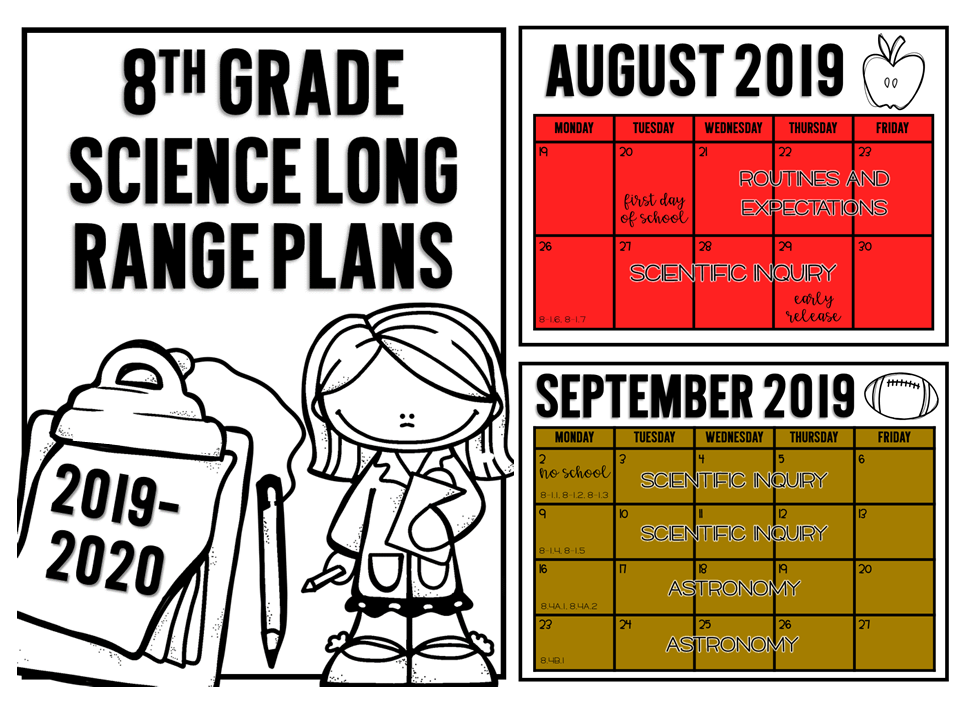
1. Start by plugging your school year dates  and holidays into your pacing guide template based off of your district calendar.

2. Using your district's suggested pacing or previous year's lesson plans, determine how long you are going to spend on each unit. I like to do it by unit first and then break it down by standard. For example, our science units are Science Inquiry, Astronomy, Earth's Structures and Processes, Earth's History and Diversity of Life, Waves, and Force and Motion. Here is an example...You get a good idea of the number of weeks to spend on each unit. This is not from my district because I cannot locate ours ANYWHERE on the internet, but you get the idea.

3. Once you have figured out the number of weeks you are going to spend on each unit, block it off on your calendar or other template.

4. Next, you want to break each unit down into smaller chunks by looking over your standards and deciding how much time you want to spend on each. Some weeks you may want to spend on multiple standards. See my example below. You will want to add the standard focus for each week and plug it into your template.  


5. This step is not necessary, but on the quarterly pacing, I like to color code it so that I know when each unit is moving to a new topic. You may also like to add your assessments into your pacing guide. I haven't done that this year because this is a new content. Maybe I'll get there next year. 😜

**It's important to remember that this is just a guide! Give yourself a couple of days here or there for things that may unexpectedly come up like assemblies, field trips, sick days, etc...** 

Here is an overview of the pacing guide templates.


They are EDITABLE and you can add your content for ANY subject, not just science. The adorable calendar guide idea was not my own! That idea was from True Tales of a Teacher! If you don't follow her on IG (@truetalesofateacher), you should. It's Instagram gold!  

Download this free template by clicking the image below. 


If you teach Science in South Carolina and are interested in the pacing guide I am using (which is already done for you), you can download it HERE


Science Survey

As I prepare for my first year as a middle school science teacher, I felt that it was important to survey my students and get their general feelings on science and assess their science knowledge.

I have always done back to school surveys for students as a way of getting to know them, so I felt like this was a great way of getting to know my students in a more scientific sense.

For a fun twist, you can also use the second version of the survey and do it gallery style! Get students up and moving to answer the questions. This is something that I have always done with my third graders at the beginning of every school year and it is such a fun way to get to know your students.


Grab this free survey by clicking my blog button below!


Student Information At a Glance {Freebie}

As you may already know, I am making the move to middle school this year, and I will have 5 classes to keep up with! I was trying to think of an easy way to have access to their information and so I came up with these information cards that I can color code by class. Self contained classes can certainly use this as well, you just wouldn't print the class tabs.


I recommend laminating the front card and the tabs for durability. Punch a hole in the corner and place on a ring and hang it next to your desk or in a spot that is easily accessible for you.

You can save your self tons of time if you have parents fill them out during Meet the Teacher or you can send them home on the first day of school with students to have parents fill them out. I personally don't want to fill out 80+  informational student cards. HAHA


Grab you FREE copy HERE!


Teaching Claim, Evidence, and Reasoning {Freebie Included}

Hey there friends! I am absolutely terrible about keeping up with this little ole blog, but I wanted to come and share with you all that I will be making the move to middle school this year to teach 8th grade science! (I know, I am a crazy person.) I have taught third grade for so many years that I just needed a change. I am VERY excited about the change and I have tons of ideas rolling around in my head.

After diving into the standards, I knew that students would need to learn to make claims and support them with evidence. This seemed to be a large theme throughout the standards so I scoured Pinterest like any good teacher and found the Claim, Evidence, Reasoning method for teaching argument writing in science.

I developed a set of resources that I think any science teacher would find helpful in teaching students to use this method with their middle level students. I love this also because the method of writing can be used in any content area! 

The unit includes:

  • A powerpoint to teach your students about the Claim, Evidence, Reasoning method
  • Claim, Evidence, Reasoning posters
  • Claim, Evidence, Reasoning doodle notes (filled in, guided, and blank versions)
  • Claim, Evidence, Reasoning guided notes mini posters for science notebooks
  • Anchor chart pieces
  • Claim, Evidence, Reasoning reference wheel
  • Claim, Evidence, Reasoning foldable
  • 2 different graphic organizers
  • Claim, Evidence, Reasoning sorting activity
  • Claim, Evidence, Reasoning Song lesson 
  • Claim, Evidence, Reasoning Candy lesson
  • 2 Claim, Evidence, Reasoning passages with writing prompt to practice the writing method
Below is a preview of all of the resources that are included in the file! I hope you find them useful! I am excited to start my year off teaching students this important skill!


As a way to thank you for sticking around, please download a copy of the doodle notes for free! Just click the image below to grab your free copy!


Classroom Management Series: Part 6 {Organizing Your Classroom}

Sooooo, this is late...again. I apologize. This has been a crazy first week back to school! I was so exhausted Thursday night after meet the teacher and then last night I fell asleep at 8:00!

Today, I wanted to take the opportunity to share with you some of my favorite classroom organization tips to help you in your classroom. These are all things that have saved my sanity or hopefully will this school year.


I saw this idea last year from Teaching with TLA and I immediately knew that this was going to solve my pencil problem. YOU KNOW what I'm talking about. Somehow, all of the pencils seem to magically disappear. I was going through pencils like crazy!! I have never found a better solution to this problem until I found this!


Each student is assigned a number at the beginning of the year. Every student uses their number for their Chromebooks, their cubbies, their headphones, etc. Anyway, I gave each student two pencils, a whiteboard marker, and eraser and labeled each with their personal numbers. They were tasked with keeping their pencil for the whole month without losing it. They must have their two pencils sharpened first thing in the morning as part of their morning routine. If one breaks, they have another one. I do also sharpen some extras and keep them at the back of the room, JUST IN CASE. But this worked amazing! No pencils were lost and students treated them like treasures! No erasers were bitten off. The points were handled with care. Seriously. I cannot tell you how happy this little chart made my heart...Definitely doing it again this year. If you have a pencil problem...You NEED to do this. These charts are available for purchase on Amazon HERE

I read a blog post many years ago by First Grader, At Last and it changed my life. I hated the whole move your clip around the chart and every kid has a different job. Honestly, I always forgot to change all the kids jobs and I just couldn't keep up with all that mess. This is literally the EASIEST thing ever! At the beginning of the year, I put all the girls and all the boys names on two separate flippable rings. The same boy and girl stay the helpers for one week. I let them do ALL the jobs! They take the attendance, they wipe the tables, they take turns leading the line and holding the door, anything you can think of! Here is an example because I never take a picture of mine. Save yourself the trouble...DO THIS. You will not regret it.


A couple of years ago, I found these AWESOME metal caddies at Really Good Stuff. They are a little pricey, but I used my back to school supply money to purchase them. They are durable and there is so much space for STUFF! I love the fact that it has the space for whiteboards or workbooks underneath. If only they came in NEON colors! 


I am implementing the book return bin this year after many years of frustration that students simply CANNOT put books back in the correct place even though EVERY bin and book has a matching label. SIGH. I am hoping this will solve all of my problems. My plan is to assign one afternoon car rider the task of returning the books for the next day.


{Photo Credit: The Creative Apple} I of course forgot to take a picture of my book return Friday...lol

For the last five years or so, I have graded papers and filed them into a bin like this. 


I use hanging file folders with students names for the inside. I purchased pretty neon ones this year. Once I grade an assignment, I put them in the kids folders. On Friday, I staple all of the students' work and pass it back for them to take home. Sometimes it ends up being every other Friday. Wooops.

I don't even think I really even need to explain this because it's like such a thing now. But, if you don't have one, you need one. I store every thing in this bad boy.


Mine looks almost just like this, except that it's black. My drawers are also all the same size. But, you get the picture. 

I have been doing this now for a really long time and it is one of the best things I have done as an educator. This year, we have a camping theme, so we have a CAMP binder. It is basically a parent communication binder. All important information goes home in the binder. We send our schedule, newsletter, class list, important papers, homework, and much more home in this binder. Students keep it all year long. It's amazing. I have parents say every year how much they love it! 

You can actually purchase my Themed Binder sets on TPT. There are many different ones included in each set. Just click on each image below! 


This will change your life. I swear. 

Drop me and comment with your favorite organization trick.