5 Fun Games for Digital Learning (Free Downloads)

This time has been incredibly difficult for teachers. Being away from our classrooms, our students, our colleagues, and our school communities has taken it's toll on us all. But, as teachers, we do what we do best. We do anything we can to serve our students and make learning online as much like our own classrooms as we can. I have been trying to find that perfect balance between the right amount of work on virtual meeting time to make sure my students are successful.

However, it is SO important to keep those connections with students going and let them know that we miss them and love them. One great way to do that is to play games with them when you meet on Zoom, Google Meet, or WebEx in my case.

I am going to talk about some really fun games that my students and I have played that I also tried to make relevant to my content area. These games could be made relevant for any content area as well.

Some of these games are a culmination of ideas I've seen on Instagram or versions of things I've seen. I will credit teachers where I can.

Scavenger Hunt with a Twist
We have all seen the typical scavenger hunt where you have students race to find items in there house and bring them back. Students LOVE this! But I was watching my IG stories one day and Kimberly from The Science Stalker suggested having students find items that started with specific letters. She had a word in mind that the first letter of each item would spell. For example, if you wanted them to unscramble the word science, you would have students hunt for things that started with each of the letters in that word (sock, clock, etc...) You would have them search for the items out of order and then have them try to unscramble the word.

I did this on Earth Day for each of my science classes. Each class had a different word related to Earth Day because you know middle schoolers like to talk to each other! Anyway, it was a big hit and they loved it! This would be a great way to introduce a lesson topic.

The Points Game

My girl Rachel at the Tattooed Teacher shared this one. This game is just a great way to connect with your students, build relationships, and just have a little fun. You will explain to students that they can earn and lose points for doing the activities that will be presented to students. If they have not done the activity, they do not gain or lose any points. You will want to give them an example like I have not yelled at anyone today so I do not lose 10 points, but I do not earn points either because this is a negative activity.

Then you present slides of different scenarios. (ie. If you have argued with someone -10, If you are wearing shoes or socks +1 per size on one slide) You can come up with as many different scenarios as you like. You can give the winner with the most points at the end a virtual prize!

Simon Says Science 

You can really do this with any subject area, but everyone knows how to play Simon Says. Just call out a statement like Simon Says touch your nose if Alfred Wegener propose the theory of continental drift. Offer some false statements like the following --> Simon Says hop on one foot if the crest is the lowest part of the wave. If students perform the action, they are out of the game.

Guess the Science Gibberish

This is another fun one that I got from Kimberly at the Science Stalker. However, I added the science twist to mine! You can download her free game HERE. For this game, it is a like the game Mad Gab. There are seemingly nonsense phrases, but when said together quickly sound like a word or phrase. I created some of my own based on our science vocabulary. You can download my editable science version by clicking HERE. We played this as a class last week and it was hilarious!

Five Second Rule

This last game is one that I plan on playing with my class this week and I think it will be a blast. You show a student a topic and they will have five seconds to name 3 things that fit the topic. For example, name three brands of shoes. My students and I will be playing this with a science twist. It will be a great way to review what we have learned and have a little bit of fun! Click the image below to download your free copy!


I hope this helps make your virtual teaching a little bit easier and little more fun! I would love to know what fun games you are playing with your students!


Science Podcast Episode Guide

So as many of you may already know, I made the switch this year to teaching middle school science and I absolutely LOVE it! I don't know why I spent so many years teaching elementary. I won't go on and on about the many reasons WHY, but just take my word for it.

Podcasts have become a big thing in education in the last couple of years. I know personally, I love listening to podcasts on my way to work every morning. True Crime is my favorite genre! My Favorite Murder and Sword and Scale are my two go to podcasts that I listen to on my daily commute.

When I taught third grade, we listened to a podcast called Six Minutes each day when we came in from recess and the students loved that time. You could hear a pin drop....It was a daily story that kept their attention and left them wanting more each day!

As a science teacher now, I've been looking for a way to incorporate podcasts into my science classroom, but just hadn't found the time to really look into all the science podcasts out there and what they have to offer. There are so many wonderful science podcasts with SOOOO many episodes.

I had a thought that I just needed to comb through each podcast and come up with guide broken down by podcast, topic, title, episode, and length so that when I want to use one, I can just go to my guide and pick one. I know this is going to make it less daunting for me to use a podcast in one of my lessons instead of spending hours (which is literally what I did creating this guide) looking for just the right episode to correspond to my lesson.

I created a Google Sheet and added tabs across the bottom for different scientific topics. At the top, I listed the title of the Podcast, the topic that the episode covers, the title of the episode, the episode date, and the length of the episode. You can see in the example below how it is set up.


Science genres included are:

  • Earth and Space
  • Biology
  • Earth (plate tectonics, oceans, atmosphere, volcanoes, earthquakes)
  • Earth's History (fossils, dinosaurs, evolution)
  • Ecology
  • Light and Sound
  • Environment
  • Weather
  • Health
  • Scientific Method
  • Chemistry
  • Physics
  • Geology
  • Genetics

The podcasts that I used are:

  • Science Weekly
  • 60 Second Science
  • Brains On Science
  • Science Friday
  • Tumble
  • Fun Kids Science Weekly
  • But Why
  • Wow in the World
  • The Show About Science
As new episodes are added to each podcast, I plan on updating the list each month. I hope you all find this document helpful for your science classrooms. If you would like to make a copy, please download it HERE

For future updates, you will need to come back and make a copy again. If you know of any other great science podcasts for kids, let me know and I will check them out and consider adding them to the guide!


3rd Grade Social Studies Pacing Guide (South Carolina 2020 Standards)

Where are my SC there grade teachers? I know many of you have been apprehensive about the new Social Studies standards that were released earlier this year. I have had so many of you ask me if I was going to be creating new social studies units for the new standards and the answer is yes!


I know I am no longer teaching 3rd grade, but 3rd grade social studies is my heart and I have so many dedicated followers that I feel like I would be letting you down if I didn't!

Today I worked on making a shortened version of the standards and a standards checklist. After I accomplished that, I really looked at what the standards were asking. I broke each standard down into smaller bits and voila, the pacing guide was born.

These standards really want students to understand the physical features, climate patterns, and cultural characteristics of places around the world, so students will spend the first part of the year learning about continents and oceans, maps, what physical features are, what culture and economy is, what climate patterns are, and how all these things work together to affect people and where they live. During each unit, students will conduct research on a specific region of the world to apply what they have learned.

You can download your free copy of this pacing guide HERE.


8th SC Science Support Document {Shortened Version}

I posted on my Instagram this past week about the shortened version of the support document that I created. The state department's version has so much extra stuff on it and I just wanted something easy to print and read! I had been thinking about doing this FOREVER and finally got around to doing it!

I hope you find this as helpful and useful as I have!

Here is a sample of what it looks like.

Click on the picture below to grab your free download!


Pace Out Your Year Like a Boss {Free Pacing Guide Template Included}

You guys know I LOVE me some planning. I get soooo excited at the end of every year for the prospect of planning for a new year. This coming year was extra exciting because I got to plan and pace for a whole new grade level and content area. I relished EVERY minute of it.

I spent a lot of time working on this pacing guide for the upcoming year, but there are a few key things you need to keep in mind when you start to pace out your year.

YOUR DISTRICT EMPLOYEE CALENDAR

This is the first thing you will need when pacing and planning out your year. This will help you create a template for your year so that you know what days and weeks to block off of your pacing guide. I always like to note the short weeks with asterisks and use the weeks for review if they are only two or three days.

HAVE A COPY OF YOUR STANDARDS

The second thing you need is a copy of your state standards on hand. These are important for a few reasons. First, they give you an idea of how long you need to spend on each topic. Second and probably more importantly, they give you your specific content to plug into your pacing guide.

USE YOUR DISTRICT'S SUGGESTED PACING

Following your district's suggested pacing is a good idea because they may already have a suggested amount of time for you to spend on each topic. It is also helpful in that students who move to another school within the district may be able to keep on track with the pacing guide and pick up relatively where they left off.

PREVIOUS YEAR'S LESSON PLANS

If you have taught the content before, you also may want to use your previous lesson plans to help you get an idea of how long you need to spend on each standard. My content is new to me this year, so I am relying heavily on my district's suggested pacing guide. I will have a better idea next year of how much time I will need to spend on each topic.

HAVE A PACING GUIDE TEMPLATE

I am providing a free pacing guide template for you to use to plug in your material. Feel free to use the one I am offering or one that you already like using. There are so many great ones out there.

Now you are ready to get started pacing your year!

1. Start by plugging your school year dates  and holidays into your pacing guide template based off of your district calendar.

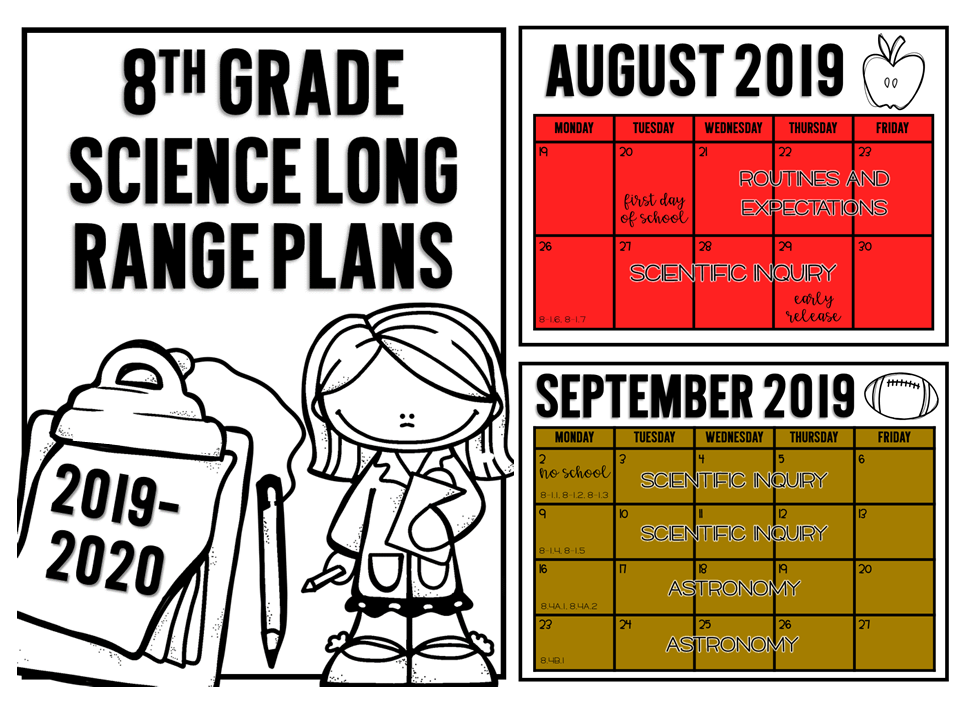
2. Using your district's suggested pacing or previous year's lesson plans, determine how long you are going to spend on each unit. I like to do it by unit first and then break it down by standard. For example, our science units are Science Inquiry, Astronomy, Earth's Structures and Processes, Earth's History and Diversity of Life, Waves, and Force and Motion. Here is an example...You get a good idea of the number of weeks to spend on each unit. This is not from my district because I cannot locate ours ANYWHERE on the internet, but you get the idea.

3. Once you have figured out the number of weeks you are going to spend on each unit, block it off on your calendar or other template.

4. Next, you want to break each unit down into smaller chunks by looking over your standards and deciding how much time you want to spend on each. Some weeks you may want to spend on multiple standards. See my example below. You will want to add the standard focus for each week and plug it into your template.  


5. This step is not necessary, but on the quarterly pacing, I like to color code it so that I know when each unit is moving to a new topic. You may also like to add your assessments into your pacing guide. I haven't done that this year because this is a new content. Maybe I'll get there next year. 😜

**It's important to remember that this is just a guide! Give yourself a couple of days here or there for things that may unexpectedly come up like assemblies, field trips, sick days, etc...** 

Here is an overview of the pacing guide templates.


They are EDITABLE and you can add your content for ANY subject, not just science. The adorable calendar guide idea was not my own! That idea was from True Tales of a Teacher! If you don't follow her on IG (@truetalesofateacher), you should. It's Instagram gold!  

Download this free template by clicking the image below. 


If you teach Science in South Carolina and are interested in the pacing guide I am using (which is already done for you), you can download it HERE